Academic, Professional, Technical, Trade, Research Books & Journals
americanpress@flash.net • 617-247-0022 • 75 State Street #100 • Boston, MA 02109
Reasoning and Writing
From Critical Thinking to CompositionDONALD L. HATCHER and L. ANNE SPENCER
3rd edition, 422 pgs, $41.95 (includes shipping)
ISBN 978-0-89641-422-8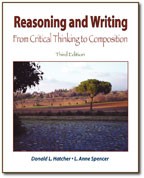
Reasoning and Writing is a college-level textbook designed for Critical Thinking classes. It is appropriate for English Composition, Communication and Journalism classes. In the third edition, the authors have improved the readability of this text by tightening the prose, adding inter-chapter references and footnotes and adding a preview paragraph and list of objectives at the beginning of each chapter. The presentation of the material in Chapters Seven and Eight has been reorganized to achieve a closer connection between the definition of critical thinking that runs throughoput the text and actual practice with argument evaluation. The crucial connection between evaluating arguments and writing a thesis has been reinforced. Much more practice material has been added. The Appendices have been re-organized and expanded to include more relevant material to critical thinking and composition.
CONTENTS
Chapter 1: WHY CRITICAL THINKING?
Introduction
Ten Arguments for the value of critical thinking
Critical thinking and writing complement each other
The limits of critical thinking and rationality
Summary and conclusion
ExercisesChapter 2: WHAT IS CRITICAL THINKING?
The nature of critical thinking
Understanding the definition of critical thinking
What critical thinking is not
Building an environment to nurture critical thinking
The skills and dispositions of critical thinking
Some hindrances to critical thinking
Summary and conclusion
ExercisesChapter 3: UNDERSTANDING THE ISSUE
Introduction
Some helpful tools for understanding an issue
Summarizing what is said
Summary and conclusion
ExercisesChapter 4: EVALUATING ARGUMENTS: VALIDITY AND DEDUCTIVE REASONING
Introduction
Opinions and arguments
Formal arguments understood as conditional statements
Formal arguments have major and minor premises
Premises and conclusions must be identified
Enthymemes are arguments with missing premises
The concept of a valid deductive argument
Symbolizing an argument shows its logical form
Implications for critical thinkers
Summary and conclusion
ExercisesChapter 5: INDUCTIVE LOGIC
On deduction and induction
Inductive generalizations based on personal experience
Inductive inferences based on controlled experimentation
The logic of correlation studies
Analogical reasoning
Summary and conclusion
ExercisesChapter 6: INFORMAL FALLACIES
The genetic fallacy
The fallacy of appealing to a questionable authority
The fallacy of appealing to ignorance
The fallacy of appealing to numbers
The fallacies of division and composition
The fallacy of equivocation
The false-cause fallacy
The slippery slope fallacy
The false-dilemma fallcy
The straw person fallacy
ExercisesChapter 7: REASONING TO WRITING
Preparing to write a critical paper
Understanding and claifying the issue
Using the Modus Ponen argument strategy
Using the Modus Tollens argument strategy
Using the Disjunctive Syllogism argument strategy
Choosing the most reasonable position
Constructing a thesis
Expanding the thesis into a sentence outline
Summary and conclusion
Review and planning sheets
ExercisesChapter 8: WRITING FROM REASONING
The critical paper
Writing and introduction
Clarifying a claim
Developing individual arguments
Presenting alternatives and objections
Writing a conclusion
The importance of editing and revision
ExercisesChapter 9: SUMMARY AND CONCLUSIONS
Glossary
Appendix A: A METHOD OF SHOWING VALIDITY
Appendix B: CRITICAL THINKING AND ETHICS
Apendix C: READINGS
Appendix D: SAMPLE CRITICAL PAPERS
INDEX
ABOUT THE AUTHORS . . .
Donald L. Hatcher is a professor of Philosophy and Religion at Baker University in Baldwin City, KS. He received his Ph.D. from the University of Kansas.
L. Anne Spencer is a professor of Foreign Languages and Computer Science at Baker University in Baldwin City, KS. She also received her Ph.D. from the University of Kansas.