Academic, Professional, Technical, Trade, Research Books & Journals
americanpress@flash.net • 617-247-0022 • 75 State Street #100 • Boston, MA 02109
Basketball for All Levels
by ROBERT C. SCHNEIDER
1st edition, 200 pages, $29.95
ISBN 978-0-89641-454-9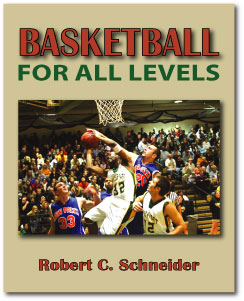
Basketball for all Levels is written in a way that will meet the needs of the non-experienced basketball neophyte, interested in “taking up” basketball, as well as the very experienced elite basketball player who is interested in further refining their fundamentals. Refined to the most rudimentary level, the fundamentals of basketball are clearly described in narrative form along with a listing of learning points. Pictorial displays of the described fundamentals are complimented with practice drills that will allow one to learn or perfect their skills. Additionally, for the teacher as well as student and player, skills tests are provided for each of the basic skills.
Basketball for all Levels addresses the fundamentals of basketball. At the beginning of each fundamental section, a brief description and the importance of the fundamental is described. After the importance of the fundamental is described, different types of the fundamentals are listed and an explanation is provided as to how to execute the fundamental. Next, teaching points are included, followed by verbal cues. Learning points for each fundamental are listed in a bulleted arrangement followed by a section that lists teaching points. Although learning points are student oriented and teaching points are instructor oriented, students will gain from teaching points and instructors from learning points. Teaching points might be described as cues that the instructor will verbalize to the student as part of the teaching process. Teaching points/verbal cues are in the form of brief words or phrases that allow for succinct delivery by the instructor and quick, clear comprehension by the player.
To further assist the student, player, and instructor, drills are included along with a battery of tests to evaluate one’s level of proficiency in each specific fundamental. Included with each specific skill is a different drill. Keep in mind, however, that most of the drills within the broad skills can be applied to the specific skills. For example the broad skill of passing includes a different drill for specific skills of passing such as the chest pass, bounce pass, and overhead pass; yet, each of the drills can be applied to any of the three specific skills. In short, coaches and teachers need not restrict their use of the drills to the specific skill under which each drill is listed.
For all drills, coaches should monitor and provide feedback to ensure that skill specific learning points are being effectively demonstrated. Although the term coaches is used, it may be interchanged with teachers/instructors or even students/players in many cases, based on your needs as the reader.
When instructing, it may not be possible to verbalize each of the listed verbal cues/teaching points throughout the sequence of the skill completion. Verbal cues/teaching points should be selected based on the areas needed to be improved upon by the player. In most cases each drill can be modified to meet the needs of the situation. For example, many times, the number of players can be decreased or increased.
CONTENTS
SECTION I— BASKETBALL HISTORY, TERMS AND RULES
- Chapter 1: Basketball History
- Chapter 2: Basketball Terms
- Chapter 3: Basketball Rules
SECTION II — BASKETBALL FUNDAMENTALS AND DRILLS
- Chapter 4: Triple-Threat Position
- Chapter 5: Passing
- Chapter 6: Catching
- Chapter 7: Shooting
- Chapter 8: Three-Point Shooting
- Chapter 9: Post Play
- Chapter 10: Perimeter Moves
- Chapter 11: Dribbling
- Chapter 12: Rebounding
- Chapter 13: Screening
- Chapter 14: Defense
SECTION III — BASKETBALL SKILL TESTS
- Chapter 15: Applications of the Learning Points Evaluation Form
- Chapter 16: Learning Points Evaluation Form