Academic, Professional, Technical, Trade, Research Books & Journals
americanpress@flash.net • 617-247-0022 • 75 State Street #100 • Boston, MA 02109
Basic Tumbling:
A Manual for Teaching Elementary through College Levelby Donald F. Staffo, Ph.D
1st edition, 62 pages, $12.95
ISBN 978-0-89641-444-0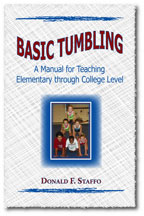
Tumbling is a beneficial activity for elementary, middle, high school and college students because it contributes to many aspects of overall fitness, including strength, flexibility, coordination, balance and kinesthetic sense, and develops discipline, courage, self-confidence and self-esteem. However some physical education teachers may lack the knowledge, confidence and skill, and therefore may feel that they are not prepared to teach tumbling. Therefore, they do not include a tumbling unit in their curriculum, or may include a brief superficial tumbling activity simply to satisfy requirements.
In either case, students are deprived of a big-muscle activity that they might enjoy that would teach them new skills that would move them closer to reaching their full movement potential. Consequently, this book is for those presently teaching physical education or prospective physical education teachers elementary school through college level who want to learn how to teach a basic tumbling unit.
Basic tumbling and gymnastics skills can be taught safely so that students, including some who are initially afraid to tumble, are not only successful in learning the skills to varying degrees, but also come to enjoy an activity that they otherwise did not believe that they could learn to like.
For 40 years the author has taught the following basic tumbling unit at the elementary school through teaching physical education majors at the college level, with classes at both extremes including students who initially either could not do a simple forward roll or were afraid to even try. Utilizing the progressive and sequential methods and approach outlined in this book in a non-competitive, pressure-free environment, the result has been that most students either learned all the skills, most of the skills, or at least showed tremendous improvement, not only in skill attainment, but in their attitude toward the activity.
The underlying premises are that if the skills are taught correctly, the students repetitiously practice the skills correctly and are allowed to learn at their own pace without pressure, skill attainment will be dramatic. The more athletically inclined will rapidly advance to a relatively high level of skill in terms of performing the skill package that follows, with those less skilled or more timid gradually making significant improvement, considering their initial baseline skill level. Said another way, since people differ in strength, flexibility, agility, baseline skill and motivation to learn, everyone will not attain even the advanced beginner stage in tumbling. However, if they adhere to what was stated at the beginning of this paragraph, almost everyone should show improvement and attain a certain level of success. Therefore, an individual's improvement, attainment of skills, and effort to learn should be considered in evaluation, rather than comparing a less-skilled student to some standard of perfection or to someone with prior gymnastics training or natural ability.
This book is intended as a guide to help instructors safely teach tumbling fundamentals in a physical education setting, not for coaching a gymnastics team. Therefore the level of skill attainment included in the following skills package will at best be advanced beginner, which is sufficient for students at the novice tumbling level in a typical physical education class at the public school and college level. It will be dependent on the philosophy, attitude, empathy and teaching methodology of the teacher whether the student(s) will leave more skilled and with not only enhanced self-esteem and a better attitude toward tumbling, or frustrated and with hatred toward what could and should be a beneficial big-muscle activity.
CONTENTS
Chapter 1: INTRODUCTION
General Objectives for a Tumbling Unit
Specific Objectives for Physical Education
Majors or Physical Educators
When Reading This Book
Class OrganizationChapter 2: BASIC SKILLS PACKAGE
Front Scale Position
Side Scale Position
L-Hold Balance
Straddle Balance
Swedish Fall
Tripod (3-Point Balance)
Headstand
Headstand from Prone Position
Tip-Up (2-Point Balance on Hands)
Handstand
Log Roll
Shoulder Roll
Forward Roll
Dive Forward Roll
Forward Straddle Roll
Backward Roll
Backward Straddle Roll
Backward Roll Extension
Backward Extension to Chest Roll
Cartwheel
Round-Off
Tinsica (Cartwheel with a Quarter Turn)
Kip
Headspring
HandspringChapter 3: EXAMPLES OF TUMBLING COMBINATIONS
Chapter 4: EXAMPLES OF BASIC PARTNER ACTIVITIES AND GROUP STUNTS
Angle Stand
Chest Stand
Knee Shoulder Stand
Swan Balance
3-2-1 Pyramid
Monkey Roll (Figure 8 Pattern)
Chain/Partner Forward Roll
Elephant WalkAppendix
Sample Student Unit Evaluation FormABOUT THE AUTHOR
Dr. Donald F. Staffo is a professor and chairman of the Department of Health and Physical Education at Stillman College in Tuscaloosa, Alabama. Prior to teaching at the college level for the past 27 years, where he has taught a tumbling skills class to physical education majors, Dr. Staffo taught elementary physical education, including an intensive unit on tumbling, for 10 years. He has also taught tumbling at the middle school and high school level. He earned his B.S. degree in health and physical education from the State University of New York at Brockport, M.A. from Western Kentucky University, and his Ph.D. from Ohio State University. He is the author of 7 books, more than 120 publications in professional journals, a weekly health and physical fitness newspaper column and over 1600 articles on physical education and sports in newsstand magazines.